Listening Mastery Section 1: Photographs
Updated: 42 minutes ago
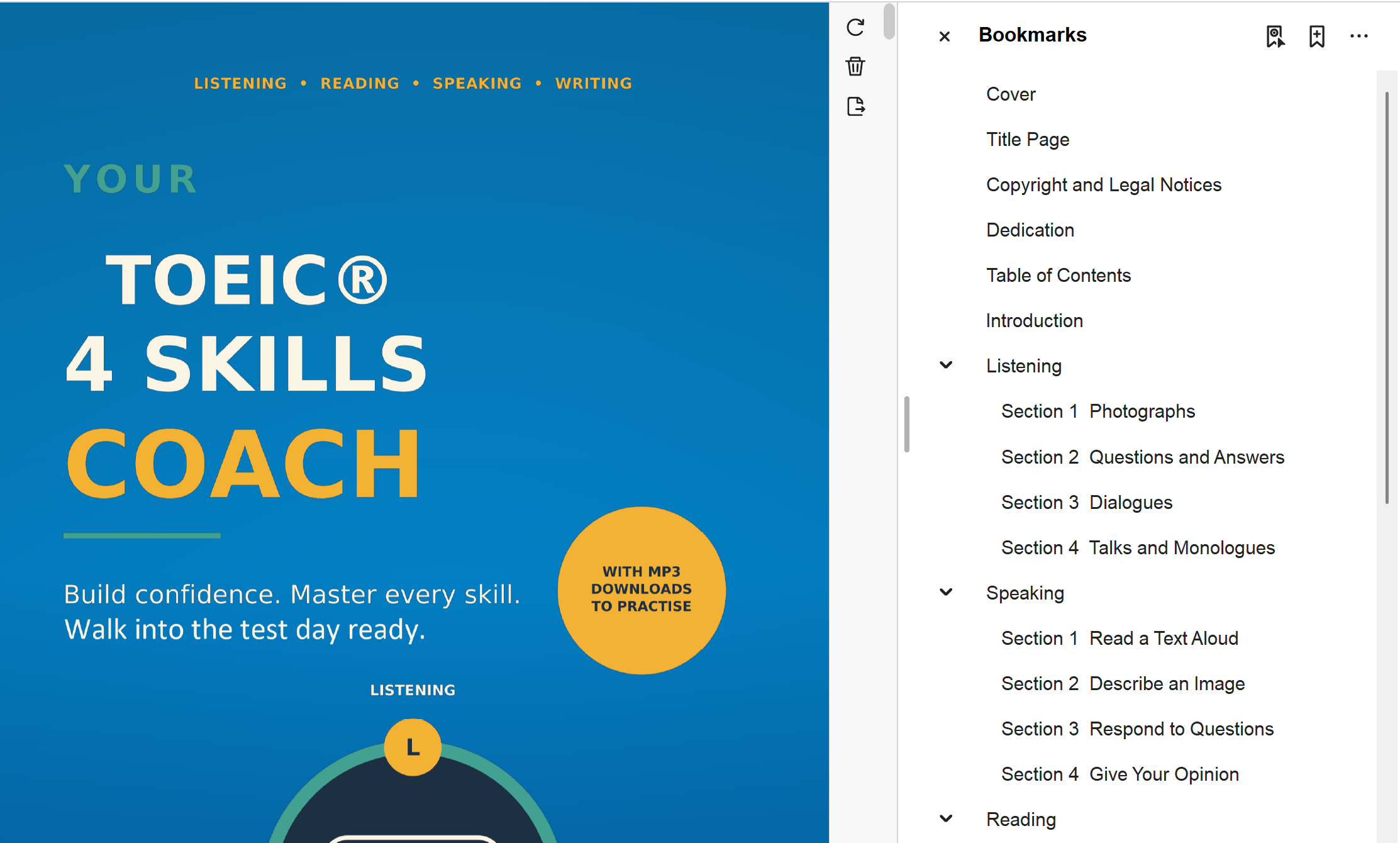
Below are some sample pages from Listening Section 1 with two practice questions and answers. This is not the full text in the chapter.
Chapter Overview
Welcome to Part 1 of the TOEIC® Listening Test — Photographs. Good news: this part is one of the most straightforward in the whole exam. Six quick questions. One chance to listen. And plenty of opportunities to pick up easy points — if you know what to do.
In this chapter, we’ll break it down step by step. You’ll discover:
• Exactly what this part tests.
• A clear strategy you can follow every time.
• Tips and traps to keep in mind.
• Score-boost moves that give you the edge.
• A vocabulary bank to train your eyes and ears.
• A mini grammar refresh.
• Practice items with full teacher’s notes and explanations.
I’ll walk you through the process, keep your confidence high, and make sure you’re ready to win those points.
1. What This Part Tests
Here’s how Part 1 works:
You’ll see a photograph. You’ll hear four short statements. Only ONE statement matches the photo. Your task? Choose it. Simple, right?
But here’s what’s really being tested:
• Actions in progress (is typing, are waiting, is boarding).
• Details — objects, positions, numbers of people.
• Places — café, station, office, hotel.
• Focus and elimination — spotting distractors and ignoring false clues.
Quick fact checks:
☐ Number of questions: 6
☐ Statements heard once, not printed in the test book
☐ Time: about 3 minutes total
☐ Scoring: no penalties for wrong answers
Coach Tip: Translation?
Even if you’re unsure, guess. Never leave a blank.
2. How to Do It (Step by Step)
Here’s your game plan. Follow this rhythm every time:
Step 1. Look first (2–3 seconds). Glance at the photo.
Ask yourself: WHO is there? WHAT are they doing? WHERE are they?
Step 2. Listen for the action. Most correct answers use the present continuous (is/are + verb+ing). Train your ear to catch it.
Step 3. Check the sentence completely. Every detail must be right — subject, action, object, place, number. One mistake = wrong answer.
Step 4. Decide fast and move on. Don’t replay in your head. Don’t overthink. Stay with the audio.
Repeat the rhythm: Look – Listen – Decide – Move.
3. Tips & Traps
DO:
- Say the action in your head BEFORE the audio starts: “She is writing”.
- Use A–O–P: Action – Object – Place.
- Expect synonyms (buy/purchase, baggage/luggage).
- Count carefully: one ≠ two ≠ group.
- Eliminate wrong choices fast.
DON’T:
- Choose an option just because you see a matching object.
- Confuse the setting: platform ≠ train; kitchen ≠ restaurant floor.
- Mix up opposite verbs: load vs unload; serve vs prepare.
- Forget small words: at / on / in front of — prepositions matter!
4. Score-Boost Strategies
Here’s how top scorers handle this part:
• Action First. Catch the -ing verb early. It’s usually the giveaway.
• Foreground, not background. The test cares about the main subject, not tiny details.
• Role clarity. Customer ≠ cashier. Speaker ≠ audience. Identify who is doing what.
• Preposition power. At the counter ≠ behind the counter.
• Fast elimination. Wrong action? Wrong place? Out.
• Stay cool. If you miss one, let it go. Don’t break your tempo.
5. Quick Success Checklist
☐ Look quickly: WHO / WHAT / WHERE.
☐ Pick the simple, literal description of what’s happening.
☐ Eliminate partial matches (object right, action wrong).
☐ Watch out for tricky pairs (load/unload, board/wait, serve/prepare).
☐ Keep your rhythm. Confidence is key.
Try this exercise:
Look around you for 30 seconds. Choose a scene and say two true sentences aloud in the present continuous.
The woman is opening her bag.
A child is waiting at the bus stop.
Do this daily. You’ll build automaticity — the kind that wins easy points in the exam.
Inspiration
Photographs test your eye as much as your ear. In daily life, you already notice what people are doing, what they’re holding, and where they are. You don’t stop to analyse — you simply see it.
That same natural skill is what TOEIC® is checking. Every practice session sharpens your reflexes until spotting the right action feels instant. Trust yourself — you already have the ability. Now it’s about training it to shine on test day.
Practice Set — Part 1: Photographs
You’re about to train with 2 exam-style photographs. Remember:
• Look quickly (2–3 seconds).
• Listen once.
• Decide fast.
• Trust the Action–Object–Place check.
After each question, read the coach’s notes carefully. That’s where the real learning happens.

Listen to the audio file, then choose which statement best describes the photo.
A. She is repairing the printer.
B. She is making a photocopy.
C. She is speaking at a podium.
D. She is taking notes at a meeting.
Coach’s Notes: Objects alone don’t define the action.
A: Machines look technical, but without tools/open panels, repair is not happening.
B: Correct — clear copying action: button pressed
C: Standing posture tempts you, but no podium, no audience.
D: Papers don’t equal note-taking — context matters.

A. They are running to catch a bus.
B. They are seated at an outdoor café.
C. They are presenting financial results.
D. They are shopping in a supermarket.
Coach’s Notes: Choose the simplest, clearest option.
A: Street background hints travel, but they’re seated.
B: Correct — literal match: café table, drinks, chairs.
C: Document tempts, but no presentation setup.
D: Bags near chairs ≠ shopping.
Conclusion
Preparing for the test requires dedication, effective strategies, and a clear understanding of the test format. By setting goals, creating a study schedule, utilising quality materials, and practising regularly, you can enhance your English proficiency and boost your confidence. Remember to manage your time effectively during the test and stay calm. With the right approach, you can unlock your test potential and open doors to new opportunities in your career and beyond. Start your preparation today and take the first step towards achieving your goals!
